
Quick summary and who should follow this checklist
Question: How to import a car into Florida?
Answer: Importing a car into Florida means moving a vehicle from another country into the state and completing U.S. Customs and Florida registration requirements so you can legally title and drive it in Florida. This guide walks you through the required paperwork, inspections, shipping choices, and timing from pickup overseas to Florida license plates.
You should follow this step-by-step import car florida checklist if you are a private buyer, a dealer bringing inventory into the state, or a business relocating company vehicles. The instructions apply whether the car arrives at PortMiami, Port Everglades, or Jacksonville (JAX). Examples use real-world scenarios relevant to southfloridaimports.com: a private buyer importing a right-hand-drive classic from Japan, and a dealer importing several European cars for resale.
Typical timeline: international shipping 2–8 weeks; U.S. customs clearance 1–5 business days; FLHSMV registration 1–6 weeks depending on local office and inspection backlog.
Why this section exists: skipping any step here creates delays at customs or when you try to register the vehicle in Florida. Use this section to decide if you should proceed and to see who this guide serves.
Import paperwork must match the vehicle exactly: VIN, make, model year and owner names are non-negotiable.

Who this is NOT for: if the car is being imported temporarily for events or short-term display and will return to the original country within the year, different temporary import rules apply and this full import-and-register checklist may not fit your needs. Also, do not use this checklist for motorcycles or boats — those follow similar but separate processes.
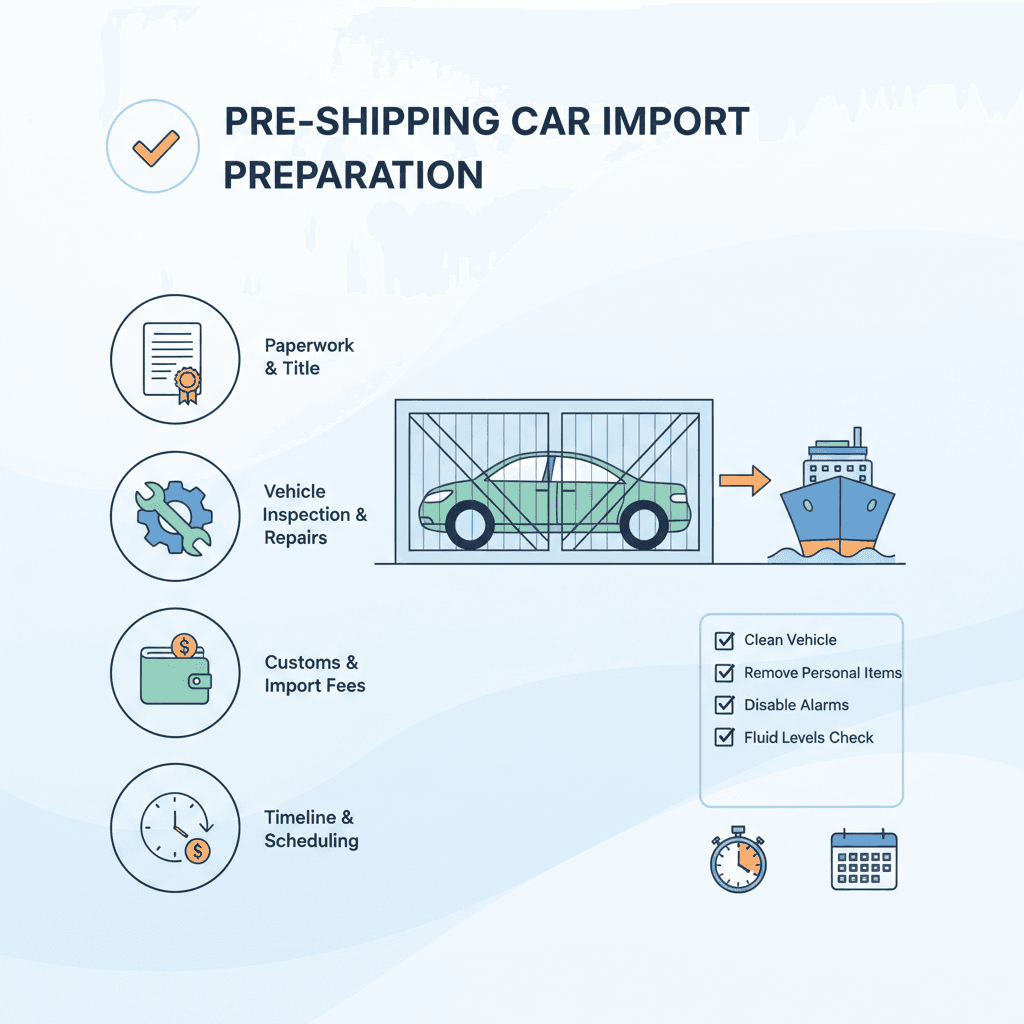
Pre-shipping preparation
If you want to import a car into Florida without surprises, start work before the car leaves the origin country. This section explains what to verify and which decisions to lock in before you sign a shipping contract.
First, confirm legal ownership and chain of title. You need a clear title or exportable equivalent from the seller. For example, a buyer importing a 1998 Nissan Skyline from Japan must obtain the original Japanese title and a bill of sale with seller contact details. If the seller lists a salvage brand or outstanding lien, resolve it before shipment.
Second, decide who handles customs clearance and port fees. Choose among: you (the importer of record), an auto broker, or your shipping company acting as agent. Using a customs broker reduces errors and speed up customs clearance; for instance, a Miami-based broker can file Entry Summary and pay duties the moment the vessel arrives. If you prefer DIY, be prepared to file correct CBP documentation and pay port handling fees on arrival.
Third, budget for taxes and duties. If your car is coming from outside the U.S., duty may apply. For typical passenger cars duty is commonly 2.5% of the declared value, but rates vary by origin and vehicle type. You also must plan for Florida sales or use tax unless an exemption applies. Contact your county tax authority to estimate exact sales tax—you will need this for budgeting and deposit purposes when you register.
Fourth, choose shipping insurance and inspect the vehicle pre-shipment. Purchase marine cargo insurance that covers total loss and damage during loading and transit. Ask the exporter for a pre-shipment inspection report and photos that show VIN, odometer, interior, and any damage. Keep copies of these documents; they help with claims and customs valuation questions.
Fifth, prepare a timeline and checklist for the origin-to-port handoff. For a standard import, plan 48–72 hours for origin-side export paperwork, 2–8 weeks transit depending on origin, then 1–5 business days for customs clearance in Florida. Use the phrase step by step import car florida when talking with brokers to ensure they know you want a full documented process, not a partial service.
Book shipping at least 2–4 weeks before your target arrival date to avoid peak-season surcharges and container shortages.
Verify DOT & EPA compliance or plan for modifications
U.S. DOT and EPA standards can block vehicle registration if the imported car does not comply. For cars built to U.S. specifications, compliance is straightforward: the manufacturer’s label will show compliance with FMVSS (Federal Motor Vehicle Safety Standards) and EPA emission standards. For example, many European imports built for U.S. sale already meet EPA and DOT rules; the sticker in the driver door jamb will indicate this.
If the car was manufactured for non-U.S. markets, it may require modifications. Common changes include lighting, speedometer units, seat belts, and emissions controls. The EPA has an import form (EPA Form 3520‑1) and the DOT uses Form HS‑7; these forms tell whether the vehicle is eligible or requires modifications. If modifications are needed, schedule a registered converter or an independent shop that can certify compliance before FLHSMV inspection.
Practical example: a buyer importing a 1995 right-hand-drive Toyota will often need state inspection and may need modifications for safety glass, headlights, and seat belts. Budget $1,000–$4,000 depending on required changes and parts availability.
Gathering essential paperwork (title, bill of sale, export docs)
Collect every document before the car leaves the origin country. Missing or inconsistent paperwork is the leading cause of customs holds and registration delays. Required documents typically include:
- Original title signed over to the importer or a certified copy of the title if the exporter retains the original for export clearance.
- Bill of sale with full VIN, sale price, seller contact info, and date of sale.
- Export declaration or export certificate from origin country (if required by exporter).
- Shipper’s bill of lading (issued once vehicle is loaded on vessel).
- Identification: passport copy for the importer and contact information.
Example checklist item: for a UK-exported car, obtain the V5C document (logbook) or a clearly documented bill of sale and any export endorsement. Translate documents to English if originals are in another language and include notarized translations when possible.
Keep digital and printed copies of all documents. Prepare a labeled folder: Title, Bill of Sale, Export Docs, Insurance Certificate, Pre-shipment Photos, and Broker Contact. This folder will travel with your broker or agent to customs and to the inspection facility.
Choosing shipping method and port — pros and cons
Choosing between shipping methods and selecting the right Florida port affects cost, risk, and speed. This section explains the main options, trade-offs, and example decisions for different scenarios.
Two primary methods move cars across oceans: roll-on/roll-off (RoRo) and containerized shipping. RoRo is usually cheaper for standard vehicles because cars drive onto a vessel and are lashed to decks. Container shipping places the vehicle inside a container; you can ship one car inside a dedicated 20-foot container or several cars in a 40-foot container if sizes permit. Container shipping is more secure and allows you to ship personal items inside the container, but it costs more.
Port selection matters for transit time, handling fees, and inland transport. South Florida ports (PortMiami and Port Everglades) are closer to South Florida repair shops and have faster local transport. Jacksonville (JAX) handles large roll-on volumes and may offer lower per-vehicle handling charges for bulk imports. If your car is arriving from Europe, JAX often has weekly RoRo service; from Asia, PortMiami and Everglades may have direct container service depending on the carrier.
How to choose: if you import a single classic that needs careful handling and security, choose containerized shipping to Port Everglades, then pick a bonded off-dock repair facility in Fort Lauderdale for modifications. If you’re a dealer importing multiple standard cars from Europe, book RoRo to JAX for lower per-unit cost and quick offload.
RoRo vs containerized shipping
RoRo pros: lower cost, faster loading/unloading, designed for standard passenger vehicles. RoRo cons: exposed to the elements and limited protection from theft; no personal goods inside the vehicle are allowed on most RoRo carriers. RoRo is ideal for late-model cars built for export to the U.S. and for dealers moving stock.
Containerized pros: excellent protection, ability to ship parts or personal items with vehicle, flexible loading locations. Container cons: higher cost, possible consolidation delays, container demurrage fees if not picked up promptly. For high-value classics or right-hand-drive conversions, container shipping often reduces risk during transit.
Example: a private collector importing a restored Italian sports car chose a dedicated 20-foot container to PortMiami with door-to-door service and white-glove handling for $3,500–$6,000 depending on origin and insurance level; an equivalent RoRo shipment would be $1,200–$2,400 but without enclosure.
Selecting PortMiami vs Port Everglades vs JAX
PortMiami: advantages include proximity to South Florida repair shops and shorter local trucking distances if you live in Miami-Dade or Broward. It handles many container and RoRo imports from Latin America and Europe. Expect higher port handling fees compared with JAX, but faster local pickup times in Miami/Broward counties.
Port Everglades: widely used for high-value vehicles and containerized imports. It has strong logistics infrastructure and bonded facilities close by. For luxury imports and vehicles requiring immediate inspection or repairs in Broward County, Everglades is often preferred.
Jacksonville (JAX): lower per-unit handling costs and strong RoRo volume make JAX attractive for dealers and bulk imports. If you plan to move cars north or to central/north Florida, JAX saves inland transport time and trucking costs.
Decision rule example: If you want lowest landed cost for standard EU-sourced inventory and can pick up from Riverside logistics, choose JAX; if you want quick access to South Florida repair shops and lower trucking time, choose PortMiami or Port Everglades.
Arrival & customs clearance step-by-step
This section shows the sequence once the vessel reaches port: what forms customs expects, who you meet, and where the car goes next. Follow these steps to avoid holds and extra fees.
- Receive notice of arrival from your shipping agent or the carrier. This contains vessel name, berthing date, and the bill of lading number.
- Confirm your importer of record and customs broker. The importer of record must be prepared to present documentation and pay duties and fees.
- Broker files entry with U.S. Customs and Border Protection (CBP). This includes the bill of lading, entry summary, and the vehicle’s invoice or bill of sale.
- CBP reviews documents and may release the vehicle or place a hold for inspection.
- If released, pay port handling, terminal, and delivery fees and arrange drayage to the bonded inspection or repair facility.
Practical example: A private buyer had a car arrive at Port Everglades. Their broker filed the CBP entry electronically the morning the vessel arrived. CBP released the vehicle in two business days after verifying the title and the HS‑7/EPA forms. The buyer paid duties and port handling fees and had the car towed that afternoon to the bonded shop for emissions testing and modifications.
Filing CBP paperwork and the HS-7/EPA forms
Two forms are central: the DOT Form HS‑7 and EPA Form 3520‑1. HS‑7 determines whether the vehicle complies with DOT safety standards. EPA Form 3520‑1 records whether the vehicle meets EPA emissions requirements or is eligible for importation as a nonconforming vehicle with subsequent modification.
Fill both forms accurately and attach supporting documentation—manufacturer labels, emissions data, or a converter’s pledge if modifications are planned. Inconsistent VINs or mismatched make/model years are common errors. Use the exact VIN on every document: bill of lading, title, HS‑7, EPA form, and broker paperwork.
For customs clearance florida vehicle matters, have a copy of the bill of sale showing value and a customs invoice if available. Proper valuation avoids CBP requests for additional evidence that stall clearance.
Dealing with holds and inspections
CBP may place a hold for random inspection, suspected mis-declaration, VIN verification, or EPA/DOT noncompliance. When that happens, you’ll get a notice describing required actions. Typical next steps are VIN verification (a physical inspection), emissions testing, or presentation of missing title documents.
Practical troubleshooting: if CBP requests VIN verification, book a bonded inspection facility immediately. Many facilities in Miami and Fort Lauderdale can perform a VIN inspection within 24–48 hours for a set fee. If the hold is for documentation, submit notarized copies and certified translations as requested. If the hold is for suspected under-declaration of value, provide the seller’s invoice, market comparables, or auction receipts to substantiate the declared value.
Transport from port to inspection/repair facility
Once CBP releases the vehicle, arrange transport from the terminal to a bonded inspection, repair, or storage facility. This section explains options, costs, and best practices to minimize damage and fees during drayage.
Options include terminal pickup by a licensed drayage carrier, third-party auto transporters, or door-to-door carriers arranged through your shipping company. Drayage carriers charge terminal access and delivery fees; expect a flat terminal pickup fee and a per-mile charge for transport. For short local moves inside Miami-Dade or Broward, typical drayage is $150–$350 depending on terminal and delivery location.
Choose bonded facilities when the vehicle still requires customs inspection or when you want to delay registration until modifications are complete. Bonded facilities can hold the vehicle under customs bond and perform modifications or inspections without releasing the vehicle to open circulation. Example: a right-hand-drive import requiring DOT conversion stays in a bonded shop until the converter certifies compliance; only then does the vehicle leave the bonded area for FLHSMV inspection.
Label your transport instructions clearly: VIN, broker contact, release number, pickup terminal, and destination address. Request proof-of-delivery that includes photos of the vehicle at arrival to document condition for insurance claims.
Florida title and registration process (forms, fees, inspections)
After clearing CBP and completing any required modifications, you must title and register the vehicle with FLHSMV through your county tax collector or license plate agency. This section lists forms, fees, and inspection steps to help you plan.
Start by obtaining a clean chain-of-title and completing any required modification certificates. Then gather the documents FLHSMV requires (listed in the next section). Expect to pay registration fees, a title fee, and local county sales or use tax calculated from the declared purchase price or fair market value. County tax collectors collect sales taxes and issue registration and plates.
Inspections: Florida may require VIN verification by a law enforcement officer or authorized inspection station. If the vehicle was modified to meet DOT/EPA requirements, bring the converter’s certification and receipts. The inspection confirms the VIN, checks for salvage branding issues, and verifies safety equipment. Only after passing inspection will FLHSMV issue a Florida title and license plates.
Example fees (illustrative): FLHSMV title fee is typically around $77 (subject to change), and registration fees vary by weight and plate type. Sales tax varies by county; in Miami-Dade the combined rate may exceed 7% including local surtaxes. Consult the county tax collector for exact figures before budgeting.
What documents FLHSMV requires and how to prepare them
FLHSMV commonly requires the following documents when you register an imported vehicle:
- Completed application for title (Form HSMV-82040 or equivalent county form).
- The original U.S. Customs entry documents showing CBP release.
- Original title or certified foreign title with translation and notarization if necessary.
- Bill of sale with VIN and purchase price.
- HS‑7 (DOT) and EPA Form 3520‑1 if applicable.
- Proof of identity and Florida residency, such as utility bills and Florida driver license.
- Proof of insurance that meets Florida minimum coverage.
How to prepare: assemble originals and two sets of copies, place them in a labeled folder, and check items against a pre-visit checklist before going to the county tax collector. Bring a converter’s certificate and repair invoices where modifications were required. If the title shows previous salvage branding, include salvage documentation and lien release letters as needed.
Post-registration checklist (insurance, inspections, modifications)
After you receive Florida title and plates, complete these tasks to make the vehicle road-ready and compliant for long-term use in Florida. This checklist helps you avoid fines and keeps insurance valid.
- Purchase or update insurance: Florida requires minimum personal injury protection (PIP) and property damage liability; maintain proof of insurance in the vehicle.
- Complete any outstanding repairs or modifications documented during registration and keep receipts for warranty and resale value.
- Schedule periodic inspections if required by local authorities or your insurance company—some modified vehicles have follow-up inspection requirements at 3 or 6 months.
- Register for emissions testing if your county requires it (Florida presently does not have statewide emissions testing, but local rules may apply to certain vehicles).
- Keep all import and customs documents in a safe place to support future resale or title transfers.
Example: after registering a restored import, the owner filed all converter invoices in a maintenance binder and scanned them to cloud storage; this increased buyer confidence during resale and sped up title transfers.
Common delays and troubleshooting (missing docs, emissions, liens)
Even with careful planning, common problems can delay registration. This section lists frequent issues and concrete remedies so you can act fast and avoid extended storage fees or fines.
- Missing or inconsistent paperwork: Remedy by obtaining notarized duplicates from the exporter, certified translations, or an apostille where required. Keep copies of emails and proof of payment to support your claim if the original paperwork is slow to arrive.
- VIN mismatch: If VINs differ across documents, request a corrected title or a certified statement from the exporter. Use VIN verification at a bonded inspection to reconcile records with CBP.
- Outstanding liens or salvage branding: Resolve liens with lienholders and obtain lien release letters; if salvage branded, follow FLHSMV salvage-title procedures which include additional inspections.
- Emissions or EPA noncompliance: If EPA raises concerns, schedule a certified conversion and obtain a certificate of compliance before re-submitting forms to CBP or FLHSMV.
Example troubleshooting workflow: a dealer faced an inland hold when CBP requested proof of previous auction sale to confirm value. The dealer submitted auction receipts and a notarized sales ledger within 48 hours, CBP released the vehicles, and the dealer avoided demurrage by picking up the cars the same day.
Downloadable checklist and printable timeline
This section provides two reusable artifacts you can copy: a florida car import checklist and a printable timeline table you can save and share.
Florida car import checklist (copyable)
- Confirm clear title and seller information
- Obtain bill of sale with VIN and price
- Check DOT/EPA compliance; complete HS‑7 and EPA forms
- Arrange marine cargo insurance
- Choose RoRo or container shipping and select port
- Hire customs broker or designate importer of record
- Track vessel and receive arrival notice
- Broker files CBP entry and pays duties/fees
- Arrange drayage to bonded inspection/repair shop
- Complete modifications and pass FLHSMV inspection
- File FLHSMV title application and pay taxes/fees
- Obtain Florida title and license plates
Printable timeline (copy or export as PDF)
| Stage | Typical duration | Action items |
|---|---|---|
| Pre-shipment | 1–4 weeks | Confirm title, arrange shipping, buy insurance |
| International transit | 2–8 weeks | Track vessel, prepare customs folder |
| U.S. customs clearance | 1–5 business days | Broker files entry, pay duties |
| Port to shop transport | 1–7 days | Arrange drayage to bonded facility |
| Modifications & inspections | 1–4 weeks | Complete DOT/EPA work, VIN verification |
| FLHSMV titling & registration | 1–6 weeks | Submit documents, pay taxes, obtain plates |
Use this timeline as a planning baseline: adjust for origin country transit times, seasonal port congestion, and whether the vehicle needs major conversions.
FAQ
What does it mean to import a car into Florida? Importing a car into Florida is the process of bringing a vehicle from another country into the U.S., clearing U.S. Customs and Border Protection, and completing Florida title and registration requirements so the vehicle can be legally driven and titled in Florida.
How do you import a car into Florida? To import a car into Florida, obtain clear title and bill of sale, choose shipping and a port, file CBP entry with HS‑7/EPA forms, clear customs, transport to a bonded facility if needed, complete DOT/EPA compliance and local inspections, and then apply for a Florida title and registration with required fees and taxes.