TL;DR
- Imported vehicles must clear U.S. Customs, meet EPA and DOT rules, and be registered with FLHSMV.
- Plan 2–10 weeks for clearance and registration; expect shipping, duty, modification, and sales tax costs.
- Use a customs broker or a trusted partner like southfloridaimports.com to reduce paperwork delays.
On a humid Thursday in Miami, a small dealer unpacked a 2016 German-market BMW that had arrived by roll-on/roll-off. Paperwork was perfect, but the car needed minor lighting changes and an EPA emissions letter before the buyer could register it locally. The dealer paid for a short compliance job, cleared customs, and sold the car within three weeks.
Why this matters: importing vehicles to Florida is common for dealers, returning residents, and specialty collectors, but a single missing form or noncompliant component can add days or thousands of dollars to the process. This guide walks through the practical steps, regulatory checks, and real-world examples you'll need to import vehicles reliably into Florida. For more on this, see How to import a car into florida.
Who this guide is for (individuals, dealers, businesses, expats)
This guide is written for people and organizations who will actually move imported vehicles into Florida and need concrete, actionable steps. That includes: For more on this, see Import car financing florida guide.
- Individuals and expats bringing a personally owned vehicle to Florida after residency change or long-term travel.
- Independent car dealers who import inventory from Europe, Japan, or other markets.
- Small fleets and businesses that purchase vehicles abroad for operations in Florida.
- Developers and website owners creating content or tools for auto import services in South Florida.
Example scenarios: a Miami collector who buys a British right-hand-drive Land Rover, a dealership in Fort Lauderdale importing demo cars from Germany, and an overseas transplant shipping a car to Jacksonville for family use. Each scenario shares the same regulatory checkpoints but varies in documentation, compliance work, and tax treatment.
Actionable takeaway: identify which category fits your situation first; the paperwork and timelines differ for personal imports versus commercial shipments. If you are a dealer, expect additional paperwork for resale, registration for business plates, and possible bonding requirements.
Who this is NOT for: Do not use this guide if you are only researching hypotheticals, not moving a vehicle in the next 12 months, or if the vehicle will remain abroad under temporary use—those situations have different rules.
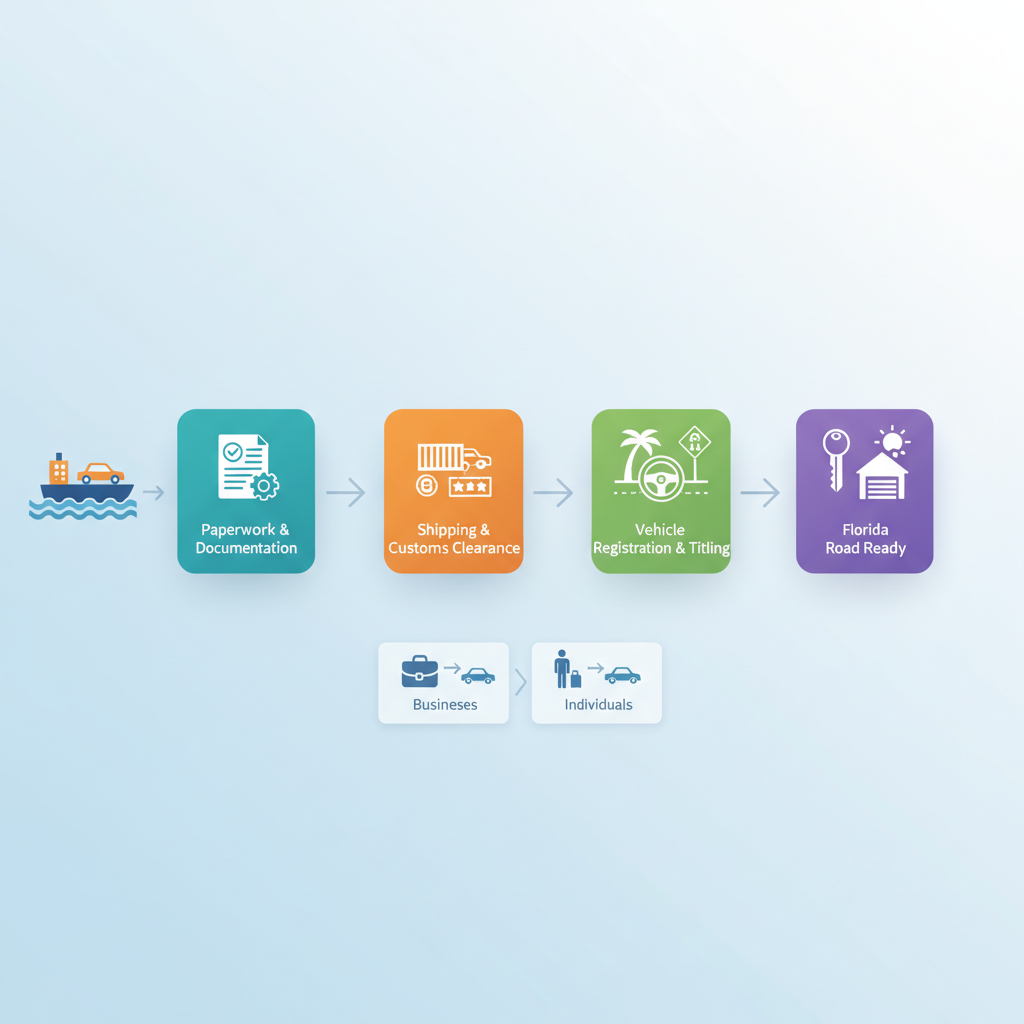
Overview — key steps to import a vehicle to Florida
This section lays out the high-level flow you will follow. Think of it as the one-page playbook before you book shipping.
- Step 1: Confirm eligibility and compliance with DOT (safety) and EPA (emissions) rules.
- Step 2: Arrange ocean/air transport to a Florida port and select a carrier or broker.
- Step 3: Prepare customs documents (title, bill of sale, bill of lading, HS-7, EPA form) and file entry with U.S. Customs and Border Protection (CBP).
- Step 4: Resolve any modifications, obtain required manufacturer letters, and clear CBP inspection.
- Step 5: Pay duties if applicable, then register and title the vehicle with FLHSMV.
| Stage | Primary action | Who typically handles it |
|---|---|---|
| Pre-shipping | Compliance check, paperwork prep | Owner or broker |
| Shipping | Transport to Florida port | Carrier |
| Customs | CBP entry and inspection | Broker/CBP |
| Post-clearance | Modifications, registration, tax payment | Local garage, FLHSMV |
Concrete thresholds: if the vehicle is less than one year old or was manufactured to U.S. specifications, expect fewer modifications; non-U.S.-spec vehicles typically require a DOT importability ruling or conversion to meet FMVSS, and that often costs $800–$4,000 depending on scope.
Actionable takeaway: complete the DOT/EPA eligibility checks before you pay for shipping. If you confirm compliance early, you avoid double shipping costs and storage fees at the port.
Is your vehicle eligible? DOT, EPA and manufacturer compliance
Begin with the definition: an 'imported vehicle' is a vehicle manufactured or first registered outside the U.S. that will be registered in Florida. Per FLHSMV, imported vehicles must clear U.S. Customs, meet EPA and DOT rules, and be registered locally. "In Florida, imported vehicles must clear U.S. Customs, meet EPA and DOT rules, and be registered with FLHSMV — expect total processing of roughly 2–10 weeks depending on origin and documentation."
DOT (safety) and EPA (emissions) compliance is the main gate. The DOT enforces Federal Motor Vehicle Safety Standards (FMVSS) and requires either that the vehicle was produced to U.S. standards or that an authorized independent commercial importer (ICI) or registered modifier brings it into compliance. The EPA requires documentation showing emissions compliance or an exemption (e.g., vehicles over 21 years old have different rules).
Specific examples:
- A 2010 Japanese-market Toyota Prius may require an emissions letter from Toyota USA or an EPA importation exemption if components differ; without it, CBP will place a hold.
- A 1995 Mercedes-Benz classic (over 21 years old) may qualify for exemption from certain EPA and DOT rules, but state registration requires FLHSMV proof of age and origin.
- A new vehicle built to European specifications with different headlamps, seat belts, or odometer units will likely need FMVSS conversions—lighting, seat belt anchors, and speedometer changes are common.
How to check eligibility:
- Contact the vehicle manufacturer to request a U.S. conformity letter or confirmation of U.S.-spec parts.
- Search the National Highway Traffic Safety Administration (NHTSA) importability database or consult a registered ICI.
- Confirm EPA emissions requirements: ask for an emissions control information label or an EPA Form 3520–1 where appropriate.
Quotable: "Imported vehicles must meet DOT safety standards and EPA emissions requirements before Florida registration."
Check manufacturer conformity before booking shipping; corrections at the port are far costlier than fixing issues pre-shipment.
Safety standards (FMVSS) and modifications
FMVSS defines crashworthiness, lighting, tires, and other safety items. If a vehicle wasn't built to U.S. FMVSS, an ICI or qualified modifier must create a conversion plan and perform modifications. Typical modifications include replacing or adjusting headlamps, installing U.S.-style bumpers or side marker lights, replacing speedometers, and ensuring airbags meet U.S. requirements.
Example: converting a left-hand-drive European van may require new side marker lights, a revised bumper structure, and confirming occupant protection systems. Conversion shops in South Florida often provide line-item estimates; expect a documented bill showing each FMVSS change to present to CBP and FLHSMV.
Actionable takeaway: get two written quotes from certified modifiers and insist on documentation that lists each FMVSS modified. Keep this paperwork with your customs submission to prevent CBP holds.
Emissions & EPA requirements
The EPA enforces emissions standards and requires either a manufacturer exemption, an EPA conformity letter, or qualifying age exemptions. For vehicles newer than 21 years, EPA compliance is strict: certified emissions components must match U.S. models or be certified by the manufacturer.
Example: a German-market diesel truck may need an emissions control label or EPA waiver; if the manufacturer won’t issue a letter, you may need an alternative compliance plan or to pay for component replacement. Gasoline cars often face fewer hurdles than diesels, but you must verify catalytic converter standards and evaporative emission controls.
Actionable takeaway: request an EPA compliance letter from the maker as soon as you agree to buy. If the manufacturer refuses, budget for conversion or plan to source a U.S-spec alternative.
Shipping & arrival — what to expect at Florida ports
Florida's major vehicle-handling ports—PortMiami, Port Everglades (Fort Lauderdale), and JAXPORT (Jacksonville)—process thousands of imported vehicles annually. Expect dock fees, terminal handling charges, and storage fees if paperwork isn't ready when the ship arrives.
Example arrival workflow: the carrier notifies your freight forwarder and the port of arrival. CBP issues an arrival notice; if the vehicle's entry is filed electronically and paperwork is complete, the car will be released to the consignee. If not, CBP will schedule an inspection and the vehicle remains in bonded storage until cleared.
Practical port specifics:
- PortMiami handles heavy volumes for Latin America and Europe and offers roll-on/roll-off and container services for cars.
- Port Everglades has robust vehicle processing and short inland trucking distances to Broward and Palm Beach counties.
- JAXPORT serves as a convenient arrival point for cars bound for northern Florida or to avoid South Florida congestion.
Actionable takeaway: plan arrival windows and verify your carrier’s Estimated Time of Arrival (ETA). Book pickup slots with the terminal or your broker to avoid multi-day storage fees; terminals often charge daily storage after a 48–72 hour free window.
Typical shipping timelines and common origins
Typical transit times depend on origin: Europe-to-Florida via container or Ro-Ro is commonly 10–20 days sea transit plus 3–10 days for port processing. Asia-to-Florida is usually 20–40 days sea transit. Air freight is faster but prohibitively expensive for most cars.
Common origins and time examples:
- Germany to PortMiami: ~12–18 days sea transit plus 3–7 days customs/processing if paperwork is correct.
- Japan to Port Everglades: ~18–30 days sea transit; used JDM cars require careful EPA/DOT checks and often take longer at customs.
- UK to Jacksonville: ~10–20 days; Brexit-era paperwork can occasionally add extra customs steps.
Actionable takeaway: account for a minimum of two weeks from vessel departure to local pickup for Europe imports; factor in additional time for modifications or CBP holds.
Port options (PortMiami, Port Everglades, Jacksonville) and broker vs direct
Choosing a port depends on final destination, carrier options, and fees. PortMiami and Port Everglades are busiest and often have higher throughput; JAXPORT can be faster for northern Florida. A broker can manage customs entries, coordinate inspections, and schedule releases. Going direct (handling paperwork yourself) can save broker fees but risks greater delays if you’re unfamiliar with CBP processes.
| Option | Benefits | Drawbacks |
|---|---|---|
| Broker | Faster clearance, expertise, fewer errors | Broker fees |
| Direct | No broker fees, full control | Higher risk of CBP holds and mistakes |
Example decision rule: if this is your first import or the vehicle is non-U.S.-spec, use a broker. If you import frequently, have established processes, and can prepare HS-7/EPA paperwork reliably, filing direct may be viable.
Actionable takeaway: if you choose a broker, ask for a written services agreement that lists exactly which forms they will file and their dispute-handling policy for customs holds.
Customs & clearance — documents and process
Customs clearance begins with filing an entry with CBP. The entry includes vehicle ID, cargo manifests, harmonized tariff numbers, and supporting documents. CBP inspects paperwork and may select the vehicle for physical inspection. Pay duties where applicable and obtain a CBP release before you can title the vehicle in Florida.
Practical example: a used car imported from Japan entered under HTS 8703.23 (used passenger cars) will likely be duty-free if shipped within certain trade programs, but documentation proving country of origin and value is still required. Without a properly executed bill of sale and bill of lading, CBP will place an admonition or hold the vehicle for proof of ownership.
Key players in the clearance process: the carrier, the licensed customs broker, CBP inspectors, and the consignee or buyer. Coordination among them cuts days off the timeline.
File the HS-7 and EPA documents before the vessel arrives to avoid terminal storage fees and CBP holds.
Required paperwork (title, bill of sale, bill of lading, HS-7, EPA form)
Required documents typically include the foreign title (or export certificate), a detailed bill of sale showing purchase price and seller, carrier bill of lading, a completed CBP entry form, DOT HS-7 declaration (stating whether the vehicle conforms to U.S. safety standards), and EPA Form 3520-1 or evidence of exemption. If the vehicle is commercial or for resale, additional dealer paperwork applies.
Specific example checklist:
- Original foreign title or certified copy
- Bill of sale with full VIN and sale price
- Ocean bill of lading or air waybill
- DOT form HS-7 (signed by importer)
- EPA Form 3520-1 or equivalent emissions letter
Actionable takeaway: assemble all originals before arrival. Scanned copies may help pre-clear paperwork, but CBP and FLHSMV will often require original documentation at inspection or titling.
CBP inspection basics and common hold reasons
CBP inspection covers identity (VIN match), ownership documents, and evidence of compliance with DOT and EPA. Common hold reasons include mismatched VINs, missing or unsigned HS-7/EPA forms, suspicious or incomplete value declarations, and missing bills of lading.
Example hold scenario: CBP inspects a car and finds the VIN plate was removed or re-stamped. That triggers a forensic VIN verification, which can add days to weeks and require manufacturer documentation or state law enforcement involvement.
Actionable takeaway: ensure VINs on the title, bill of sale, and vehicle match exactly. If the vehicle has nonstandard VIN locations (classic cars), get pre-approval documentation from the state and a notarized history to speed inspections.
Florida registration and titling after import
Once CBP releases a vehicle, you must register and title it with the Florida Department of Highway Safety and Motor Vehicles (FLHSMV). The state requires proof of ownership, proof of identity, proof of Florida insurance, and the CBP entry documents showing duties paid or exempt. FLHSMV inspects the vehicle for VIN verification and may require emissions certificates depending on county requirements.
Example: a vehicle imported and cleared at Port Everglades will need the CBP 5106 or similar release form, the original title, and a completed Florida title application at a local tax collector’s office. Dealers register on commercial paperwork and may handle fleet titling differently, so review FLHSMV dealer requirements.
Quotable: "Register imported vehicles with FLHSMV using the CBP release, original title, and proof of Florida insurance."
Actionable takeaway: schedule your FLHSMV visit after CBP release; bring originals and certified translations if documents are in another language.
FLHSMV requirements and inspection points
FLHSMV requires VIN verification, odometer disclosure, and proof of identity. Some counties have emissions or safety inspection requirements for registration, though Florida’s statewide inspection requirements are limited compared with some states. The tax collector's office will calculate registration fees and documentary stamp taxes when transferring ownership.
Example inspection points: confirm that the VIN plate is secure, the odometer reading is recorded on the title, and vehicle lights and signaling meet U.S. norms. If the vehicle needed DOT modifications, bring the modifier’s invoice and certification to FLHSMV to avoid title delays.
Actionable takeaway: print the FLHSMV title application checklist and tick each item before you go; missing a single document can force a return trip and additional fees.
Sales tax, use tax, and local fees — what triggers payment
Florida sales tax is administered at 6% with county discretionary surtaxes. Sales or use tax is generally due when registering the vehicle in Florida. If you paid foreign VAT or other taxes, consult a tax advisor; Florida typically taxes the price paid or fair market value depending on documentation. Dealers have different collection rules than individuals.
Example tax scenarios:
- An individual imports a car purchased abroad for personal use: the tax collector will collect the 6% state tax plus local surtax on the purchase price when titling.
- A dealer imports inventory for resale: the dealer may defer tax collection until sale, but must maintain accurate inventory and customs cost records.
Actionable takeaway: calculate the expected tax using the purchase price in your bill of sale and add your county surtax when budgeting. Keep precise paperwork to show CBP value and avoid valuation disputes.
Insurance and road-readiness (temporary permits, insurance proof)
Florida requires proof of insurance to register a vehicle. Before registration, you can obtain a temporary moving permit or trip permit in certain cases to move the vehicle from the port to a compliance shop. Transport companies or carriers sometimes provide temporary coverage while the vehicle is in transit, but you must secure Florida-compliant insurance before driving on public roads.
Example: a collector importing a classic car may buy non-owner or classic-car insurance that covers transport to a modifier and until the vehicle receives a Florida plate. Dealers typically provide dealer plates for test drives and transport.
Actionable takeaway: arrange insurance and temporary permits before pickup. If you plan on driving the vehicle from the port, bring the insurer's declaration page and the permit to the terminal to avoid gate refusal.
Typical timeline and cost ranges (shipping, duties, registration)
Estimated timelines and costs vary widely by origin, vehicle age, and compliance needs. Below are conservative example ranges you can use for budgeting. These are illustrative; obtain quotes for precise estimates.
- Sea freight (Europe to Florida): $1,200–$3,000 for Ro-Ro or container, depending on service and season.
- Customs broker fees: $150–$600 for standard entries; more for complex cases.
- Duty: passenger cars imported from countries without free-trade agreements typically face 2.5% duty; trucks and other categories differ.
- Modifications/conversion: $800–$4,000 for minor safety and emissions adjustments; classic car work can be more.
- FL registration and title fees: $225–$400 typical for initial registration and title transfer, plus 6% state sales tax and county surtaxes.
Timeline example (typical, not guaranteed):
- Pre-shipping compliance check: 3–14 days.
- Transit time: 10–30 days depending on origin and routing.
- Port processing & CBP clearance: 1–14 days, longer if inspection or modifications are needed.
- Modifications and local certification: 2–14 days depending on shop schedules.
- FLHSMV registration: 1–5 days once all paperwork is in order.
Actionable takeaway: budget 2–10 weeks from purchase to registration for most imports; factor in potential delays for noncompliant vehicles and seasonal shipping congestion.
Common pitfalls and how to avoid delays
Common pitfalls include missing HS-7/EPA forms, mismatched VINs, late manifest filing, and insufficient proof of ownership. Each causes CBP holds, storage fees, and additional labor. A typical avoidable problem is relying on scanned titles without having the original available for inspection.
Real-world examples and fixes:
- Missing HS-7/EPA: Request and sign these before the vessel sails. If you wait until arrival, expect unpaid terminal storage and potential demurrage.
- VIN mismatch: Compare the VIN on the foreign title, bill of sale, and bill of lading. If the plate is different, obtain manufacturer documents or a notarized chain-of-title to explain differences.
- Value disputes: Keep an accurate bill of sale and receipts for modifications. If CBP questions value, provide invoices for accessories, shipping, and conversion costs.
Actionable takeaway: create a pre-shipment checklist and run it with your broker or southfloridaimports.com before the car leaves port. Preventing one paperwork error will usually save more than the broker fee.
Checklist & downloadable action plan
Use this checklist at purchase, before shipping, on arrival, and before FLHSMV registration. It’s designed to be copied into a task manager or printed for the person handling the import.
| Phase | Task | Completed (date) |
|---|---|---|
| Pre-shipping | Obtain manufacturer DOT/EPA conformity letters; confirm VIN and title | |
| Pre-shipping | Complete HS-7 and EPA form 3520-1 if required | |
| Shipping | Book carrier and choose port (Miami/Everglades/Jacksonville) | |
| Arrival | Confirm CBP entry filed and broker notified | |
| Post-clearance | Arrange modifications and obtain receipts | |
| Registration | Gather CBP release, original title, proof of insurance, ID and visit FLHSMV |
Downloadable action plan: copy the checklist above into your project tool and assign each task a due date tied to the vessel ETA. For example: "HS-7 completed by 7 days before ETA; broker entry filed 48 hours before arrival."
Actionable takeaway: keep a central folder (digital and physical) with originals and PDFs of all documents; present the PDF to brokers for pre-clearance and the originals to CBP or FLHSMV when required.
How our SaaS can help (automation for publishing, checklists, and provider integrations)
southfloridaimports.com helps by automating the document checklist workflow, providing provider integrations (carriers, customs brokers, and local modifiers), and publishing status updates to stakeholders. For example, a dealer can use the platform to automatically generate HS-7 and EPA checklists, route them to a broker for review, and track the CBP entry status in real time.
Specific features that solve real problems:
- Checklist templates prefilled for common origins and vehicle types to avoid missing forms.
- Provider directory with vetted modifiers and shipping partners in South Florida to reduce lead time for conversions and carrier booking.
- Automated reminders tied to vessel ETA to ensure HS-7 and EPA forms are filed before arrival.
Example: a small dealer imported a European demonstration vehicle and used the platform’s provider integration to book a local converter; the platform sent the broker pre-filled forms and removed a two-day delay the dealer would otherwise have faced.
Actionable takeaway: use a workflow tool that centralizes documents and timestamps approvals; that audit trail resolves disputes with CBP or FLHSMV faster than ad hoc email threads.
Next steps — links to in-depth sub-guides and services
Recommended next steps:
- Classify the vehicle (personal, dealer inventory, fleet) and identify the critical forms required.
- Contact the manufacturer for DOT/EPA letters before purchase.
- Get a customs broker quote and a local modifier estimate if the vehicle is non-U.S.-spec.
- Use the checklist above and schedule tasks by vessel ETA.
FAQ
What is importing vehicles to Florida?
Importing vehicles to Florida is the process of bringing a vehicle manufactured or first registered outside the U.S. into Florida, clearing U.S. Customs, meeting EPA and DOT rules, and registering the vehicle with FLHSMV.
How does importing vehicles to Florida work?
The process involves confirming DOT and EPA compliance, arranging ocean or air transport to a Florida port, filing entry documents with CBP (including HS-7 and EPA forms), clearing inspections, paying duties and taxes as required, and registering the vehicle with FLHSMV.
Quotable: "Plan for 2–10 weeks from shipment to registration for most imported vehicles, depending on origin and documentation."
Use this guide as your starting checklist and consult southfloridaimports.com or a licensed customs broker for execution help tailored to your vehicle and situation.